

Plastic Surgery and Beauty Concept
17/03/2024-
What are our Surgical Practices?
17/03/2024


A deep plane facelift is a comprehensive facial rejuvenation procedure that addresses the face as a whole. Rather than tightening the skin alone, this technique works by releasing the deeper supportive tissues of the face as a single anatomical unit and repositioning them upward and backward for a more natural, refreshed appearance.
the patient may be a suitable candidate for facelift surgery.
What Areas Does Facelift Surgery Address?
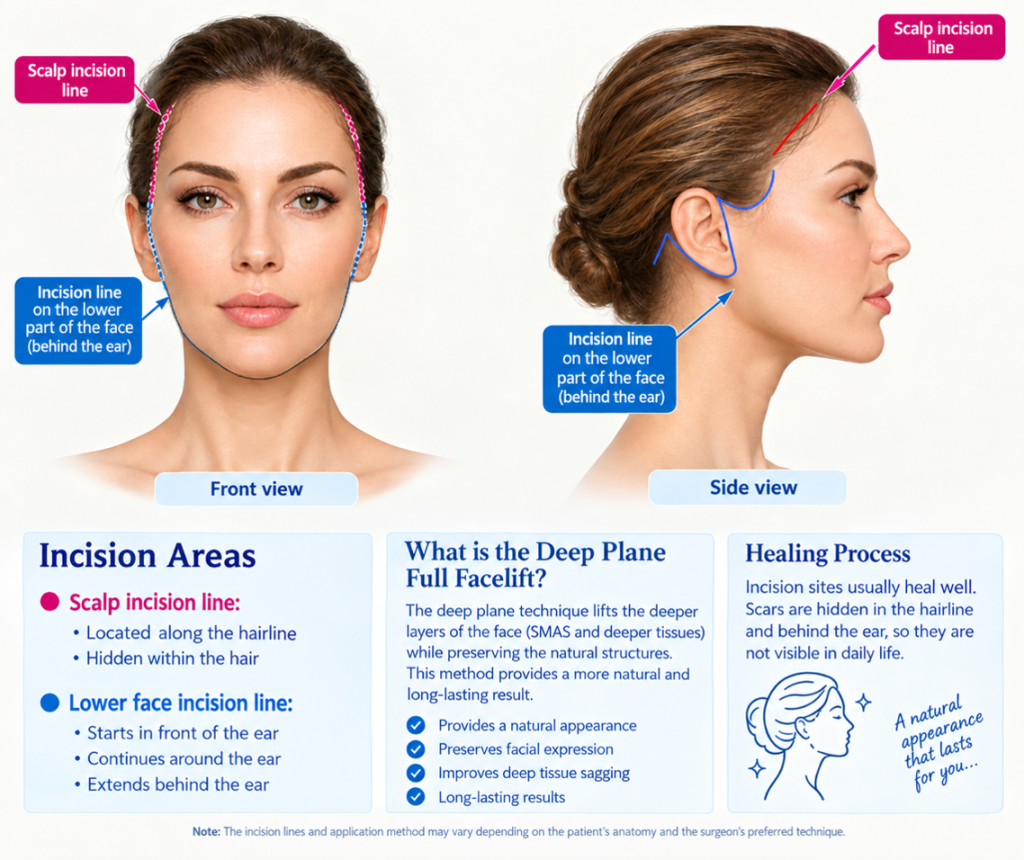
What Is the Surgical Incision and Planning Like?
For a deep plane facelift, incision sites are generally planned in two main areas:
What Is the Recovery Period Like?
Facelift surgery typically requires a 7-day recovery period, during which a facial compression garment may be used. Since swelling and bruising can occur during this time, patients are advised to rest. Swelling usually decreases significantly within approximately 20 days. It may take between 6 months and 1 year for the face to settle into its natural final shape. Within 2 to 4 months, the incision areas generally mature into fine lines and become much less noticeable.
Depending on the patient’s individual needs, facelift surgery may be performed on its own or combined with additional procedures. The most common facial procedure combinations we perform include:
Is facelift surgery a difficult procedure, and how long does it take?
Facelift surgery is generally not considered a very difficult or painful procedure. Depending on whether additional procedures such as eyelid surgery or neck lift are included, it typically takes approximately 2.5 to 4.5 hours.
What are the possible risks and complications of facelift surgery?
As with any surgical procedure, facelift surgery may involve risks such as bleeding, bruising, swelling, asymmetry, and scarring. These risks can be minimized as much as possible through the surgeon’s appropriate approach and the patient’s strict adherence to postoperative instructions.
Does facelift surgery have any side effects?
Facelift surgery does not have specific side effects unique to the procedure, and its surgical risks are not higher than those of other aesthetic surgeries.
Will there be visible scars after facelift surgery?
Because facelift surgery is performed through incisions placed within or along the hairline at the temples, around the sideburn area, and in front of and behind the ear, scars may be visible in these areas at first. However, they gradually fade over time and become much less noticeable. In the long term, the scars typically become very subtle and are usually difficult to detect unless examined very closely.
How long do the results of facelift surgery last?
The results of facelift surgery are generally expected to last approximately 8 to 10 years. This duration is directly related to the patient’s individual tissue characteristics.
What should be done before facelift surgery?
Before facelift surgery, our doctor evaluates the patient and creates a personalized surgical plan. The surgery date is then scheduled. As with all surgical procedures, smoking should be stopped 2 weeks before surgery. Blood-thinning medications, herbal teas, vitamins, and weight-loss medications should not be used during the week before surgery. Only medications that the patient must take due to existing medical conditions should be used with the doctor’s knowledge and approval. The patient will also be informed about how many hours they should fast before the surgery.
Why is it important to stop smoking before facelift surgery?
Because smoking significantly affects wound healing, it is strongly recommended that patients avoid smoking for 15 days before and 15 days after surgery. Patients should be aware that smoking is one of the main causes of poor wound healing.
How should I sleep after facelift surgery?
During the first few days after surgery, patients should sleep with their head elevated, using 2 to 3 pillows, to help prevent increased facial swelling and support its gradual reduction. After the first week, there is usually no need for a specific sleeping position restriction.
How is dressing care performed after facelift surgery?
After facelift surgery, no dressing change is usually required as long as the surgical tapes placed during the operation remain in place. There may be minimal drainage in the dressing area. Your doctor will check the incision sites over the tapes at regular intervals, and the tapes are usually removed after 7 days. After that, dressing care is typically no longer needed. Your doctor may recommend creams to apply along the incision line.
When can I return to work after facelift surgery?
After facelift surgery, the tissues generally heal sufficiently within 7 days. After the 7th day, patients can usually return to social life without any significant issues.
When can I start exercising after facelift surgery?
During the first 3 days after facelift surgery, patients are generally advised to rest, walk around the house, and perform only simple daily activities. After 3 days, short outdoor walks may be taken cautiously. However, heavy lifting and strenuous exercise are not recommended during the first few weeks. In general, all types of sports activities are usually allowed after 2 months.
Will I need to wear a facial compression garment after facelift surgery?
After facelift surgery, a facial compression garment and bandages will be applied to provide gentle pressure to the treated area. The compression garment should be worn continuously for as long as your doctor recommends. In general, after 7 days, it may no longer be needed, depending on your doctor’s guidance.
Is a drain placed during facelift surgery?
After facelift surgery, your doctor may use a drain to help prevent blood accumulation in the treated area. The drain is usually removed easily on the 3rd day. This is not a painful procedure.
Will the stitches need to be removed after facelift surgery?
In facelift surgery, the sutures are completely hidden, so there is usually no need for stitch removal.
Is facelift surgery very painful?
Most patients report little to no pain after facelift surgery. However, mild tightness and discomfort in the surgical area can be expected. Regular use of the prescribed antibiotics and pain medications is usually sufficient.
When can I shower after facelift surgery?
During the first few days after surgery, the incision areas should not be exposed to water. In general, face washing and showering are allowed after the 7th day. In the early period, very hot or very cold water is not recommended while showering.
When can I swim in a pool or the sea after facelift surgery?
It is generally recommended to wait approximately 1.5 months before swimming in a pool or the sea.
When can I travel after facelift surgery?
Short-distance travel by car may be possible after 4 days following facelift surgery. For a 1- to 2-hour flight, it is generally appropriate to wait until 7 days have passed.
How long should sexual activity be avoided after facelift surgery?
Because blood pressure may increase during sexual activity, which could lead to unwanted bleeding in the face after surgery, patients are generally advised to wait 3 weeks before resuming sexual activity.
When can I wear makeup and dye my hair after facelift surgery?
Makeup may usually be applied 7 days after facelift surgery. Hair coloring is generally recommended after 8 weeks.
When can I start sunbathing or use a solarium after facelift surgery?
Sunbathing and solarium use are not recommended during the first 3 to 4 months after facelift surgery, as the surgical areas may be affected and scars may darken.
What is the cost of facelift surgery?
In order to provide clear information about facelift surgery pricing, the patient’s concerns and aesthetic expectations must be objectively evaluated, and the required procedures must be determined. Pricing information will be provided after the consultation.
If you have any questions regarding surgeries or would like to be evaluated by Plastic, Reconstructive and Aesthetic Surgery Specialist Op. Dr. Fatih Söylemez, you can request an appointment via WhatsApp or Contact Form now.


